





.svg)
.svg)
.svg)
.svg)
.svg)
Sign up to upvote!
In addition to upvoting, unlock exclusive content and community benefits by joining our online forum

You don't have permission to view that page. Please upgrade your plan or log in to continue.
Here we go again down another rabbit hole.
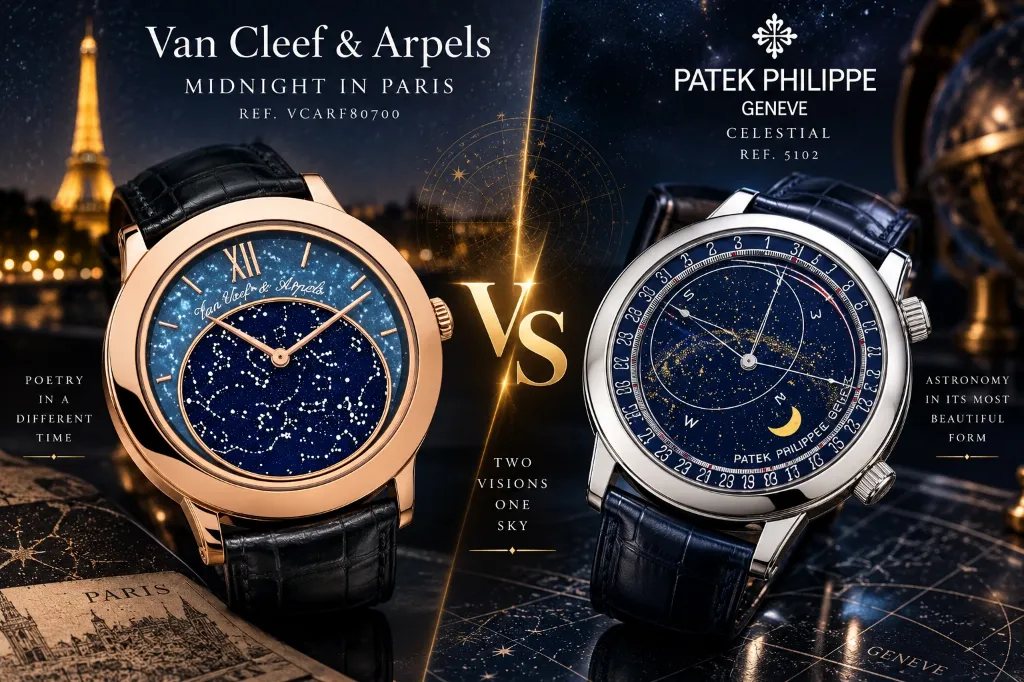
This one started because I was looking at the Van Cleef & Arpels Midnight in Paris, ref. VCARF80700, and something about the watch kept bothering me in a good way.
Most collectors probably see Van Cleef & Arpels and immediately think jewelry maison. Beautiful design, precious stones, artistic watches… but maybe not the first name that comes to mind when we're talking serious mechanical horology.
Then you start researching the watch.
And suddenly things get interesting.
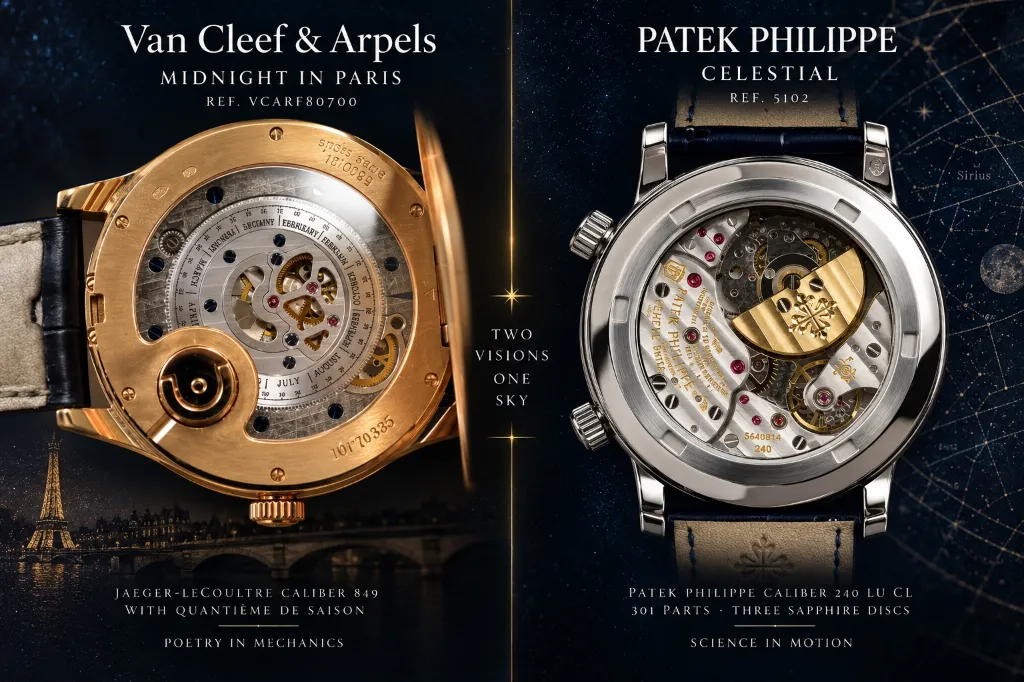
Inside the Midnight in Paris is a manually wound Jaeger-LeCoultre caliber 849, combined with a Quantième de Saison mechanism. Its rotating aventurine-glass celestial display depicts the stars above Paris and moves almost imperceptibly over the course of a year.
The watch dates to around 2007, and behind the complication sits a name we've talked about before:
Now you have my attention.
Because this isn't simply a jewelry company putting stars on a pretty blue dial.
There's some serious watchmaking hiding underneath.
And naturally, my brain went somewhere else.
Five years earlier, Patek Philippe had approached the same basic idea from a completely different direction with the Celestial ref. 5102, introduced in 2002.
Instead of simply creating a beautiful representation of the heavens, Patek built a mechanical astronomical display showing the apparent movement of the stars, the orbit and phases of the Moon, and the meridian passage of Sirius.
And that's when I started asking myself:
Obviously, we're talking about Patek Philippe versus Van Cleef & Arpels. I'm not pretending the names carry the same weight in traditional haute horlogerie.
But forget the names for a second.
Imagine neither watch had a logo on the dial.
Which complication is more difficult? Who engineered them? Which came first? Which is harder to find? And how much watch are we actually getting for our money?
Because the price difference isn't small.
That doesn't automatically make the Van Cleef a bargain.
And it certainly doesn't make the Patek overpriced.
Maybe once we understand what's happening mechanically, Patek completely destroys it.
That's what I wanted to find out.
The more I researched them, the more I realized these watches aren't really trying to accomplish the same thing.
The Van Cleef is about poetry.
Its celestial display moves so slowly that the rotation is essentially invisible. You don't watch the complication move.
You experience it over time.
That's very Jean-Marc Wiederrecht.
Patek approaches the sky from almost the opposite direction.
The Celestial isn't merely trying to remind you of standing under the stars.
It's trying to mechanically model what they're doing.
And the numbers behind that are ridiculous.
When Patek developed the astronomical system that eventually found its way into the Celestial, its engineers calculated more than:
25,000,000,000,000
possible transmission-ratio combinations.
From those combinations, Patek selected the gearing that minimized deviations across the astronomical indications. The resulting 5102 uses Patek Philippe's automatic caliber 240 CL LU (240/165), with 301 components, 45 jewels, a 22K gold micro-rotor and three superimposed sapphire discs creating the celestial display. The mechanism was protected by Swiss patent CH 688 171 B5.
So already we have our first major distinction:
Before Paris, There Was Geneva
Who Put the Night Sky on the Wrist First?
Patek got there first.
And not by a little.
The Celestial story really begins on October 5, 2000, when Patek unveiled the Star Caliber 2000, an extraordinary double-faced astronomical pocket watch created for the new millennium.
Among its innovations was a patented system capable of displaying the night sky, apparent movement of the stars, position of the Moon and its phases.
The astronomical work developed through the Star Caliber 2000 program soon found its way into wristwatch architecture with the extraordinary Sky Moon Tourbillon ref. 5002.
Then came the Celestial ref. 5102 in 2002, placing the sky itself front and center.
The watch displays the northern sky as seen from Geneva's latitude, including the apparent movement of the stars, angular motion and phases of the Moon, meridian passage of the Moon and Sirius, and mean solar time.
Three sapphire discs rotate at different speeds beneath an ellipse defining the portion of sky visible above Geneva.
And underneath everything sits a movement only 6.26 mm thick.
That's already impressive.
But then I discovered something that gives the 5102 another level of provenance.
It won the 2002 GPHG Aiguille d'Or.
Not a category prize.
The Aiguille d'Or Grand Prix, the highest overall honor at the Grand Prix d'Horlogerie de Genève.
That matters.
We're looking at this watch more than two decades later and judging it with the benefit of hindsight. But in 2002, the watchmaking industry itself was already recognizing the 5102 as something exceptional.
The Celestial ref. 5102 carried a documented retail price of CHF 180,000 including VAT when it debuted in 2002.
For some perspective, using the average CHF/USD exchange rate for 2002, that was approximately:
$116,000 USD
in 2002 dollars.
That's important when looking at today's market. More than two decades later, examples of the 5102 still trade deep into six figures, depending on metal, condition, completeness and provenance.
So while comparing a 2002 purchase directly with today's auction results doesn't account for inflation or opportunity cost, one thing is clear:
Then Paris Looked Up
Around 2007, Van Cleef & Arpels introduced the Midnight in Paris ref. VCARF80700.
And here's where the comparison becomes interesting.
Van Cleef didn't try to beat Patek at its own game.
They didn't build a 301-component astronomical movement or attempt to reproduce every celestial indication.
They asked a different question:
What if we could put the feeling of standing underneath the Paris night sky on your wrist?
And for that, they turned to Jean-Marc Wiederrecht and Agenhor.

Wiederrecht is one of those people whose fingerprints are all over modern high-end watchmaking even though his name rarely appears on the dial, Harry Winston, Hermès, MB&F, Fabergé, Van Cleef and others.
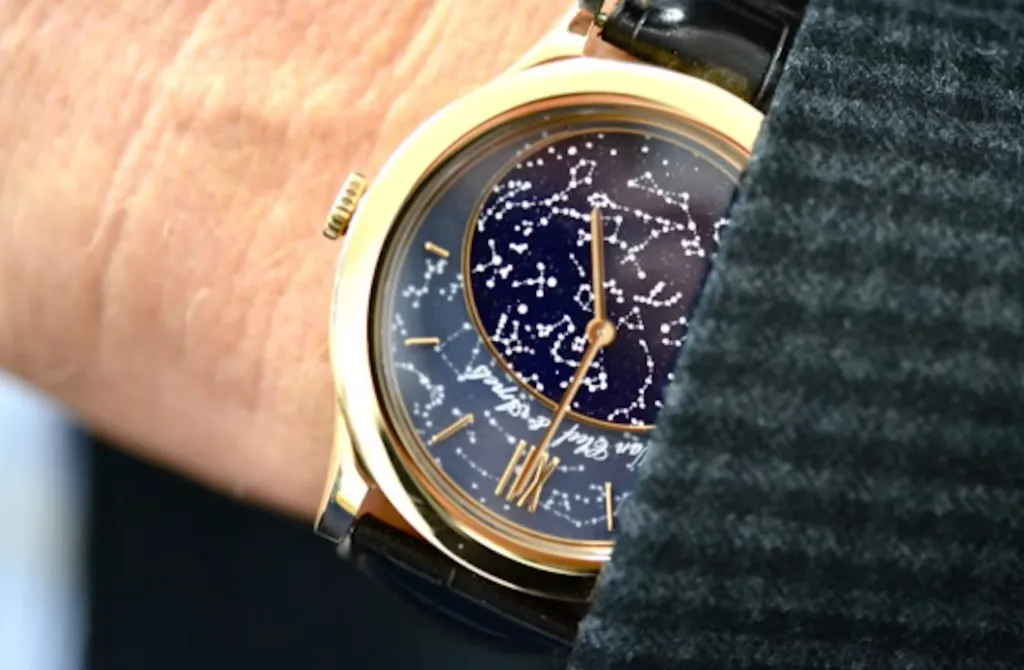
The Midnight in Paris starts with the manually wound JLC 849, but the celestial mechanism is where the story becomes interesting. Period reporting directly connects Agenhor with the watch, and Wiederrecht himself was photographed wearing one. The celestial disc was reported to complete one rotation every 365.25 days.
You're not watching seconds.
You're watching seasons.
And here's another little piece of history I didn't know when I started researching it:
The Midnight in Paris competed at the 2007 GPHG.
It didn't win a prize, but it was there.
Five years after the Celestial won watchmaking's biggest prize, the Midnight in Paris appeared on that same GPHG stage as a men's-watch competition entry.
I think that's worth mentioning because it reinforces what Van Cleef was beginning to do during this period.
This wasn't simply jewelry with a movement inside.
And Then There's the Dial
This might be where Van Cleef starts fighting back.
Mechanically, I'm giving the advantage to Patek.
I don't think that's controversial.
But visually?
Now things become subjective.
The Midnight in Paris uses a rotating aventurine-glass disc surrounded by frosted blue quartz to depict the constellations.
Christie's documents exactly that construction on a numbered example from 2007, powered by the manually wound JLC 849 and housed in a 41 mm pink-gold case.
Aventurine is almost unfair for this application.
Its sparkling inclusions already look like stars suspended in a night sky, so the material itself becomes part of the illusion.
Then turn the watch over.
There's a hinged officer-style caseback.
Open it and the personality of the watch changes completely.
The poetry on the front gives way to the mechanics underneath, with the seasonal calendar surrounding the movement and providing the reference for setting the celestial display.
The front tells you the story.
The back explains how the story works.
So Who Built the Better Watch?
If we're judging purely by astronomical complexity:
Patek. Easily.
The 5102 is on another mechanical level.
Three sapphire discs. Multiple astronomical indications. 301 components. Patented architecture. Twenty-five trillion transmission-ratio calculations.
And the 2002 Aiguille d'Or sitting behind it. Van Cleef isn't trying to compete with that. And pretending otherwise actually makes the Midnight in Paris less interesting. Because its achievement is somewhere else.

One is trying to tell me where the Moon and stars are.
The other is trying to remind me what it feels like to look at them.
And depending on what kind of collector you are, I'm not convinced the answer to “Which one would I rather wear?” is automatically Patek.
Especially when we start talking about money.
And This Is Where Things Get Interesting
The Patek gives us a very clean historical number: approximately $116,000 USD in 2002, based on its documented CHF 180,000 retail price and the average CHF/USD exchange rate for that year.
More than two decades later, 5102s still trade deep into six figures, with the exact result depending heavily on metal, condition, completeness and provenance.
That doesn't make it a perfect investment comparison, we're not adjusting for inflation or opportunity cost, but it does tell us something:
The Celestial has retained serious nominal value.
The Van Cleef tells a very different story.
Christie's sold a numbered VCARF80700 for HKD 350,000 in 2018, roughly $44,600 USD at the exchange rate around the time of the sale, while more recent secondary-market asking prices have appeared around the low-$30,000 range.
I'm not the guy buying it new in 2007.
I'm the guy looking at it after much of the depreciation appears to have already happened.
And suddenly the story changes.
Today, roughly speaking, you're looking at a precious-metal Van Cleef poetic complication with a JLC base movement, Agenhor involvement, an aventurine celestial display, GPHG competition history and a fascinating mechanical story for a fraction of what a Patek Celestial commands.
That doesn't make it the better watch.
It might make it the more interesting buy.
I went into this rabbit hole thinking I was comparing two watches that put the night sky on the wrist.
I came out realizing they're really not trying to do the same thing at all.
The Patek Philippe Celestial is clearly the greater astronomical achievement. The mathematics, engineering and mechanical architecture are on another level, and its 2002 Aiguille d'Or reinforces just how important the watch was when it appeared.
But the Midnight in Paris doesn't need to beat Patek at that game.
Wiederrecht and Van Cleef took a simpler mechanical idea and turned it into something emotional.
And at today's very different secondary-market prices, that makes the Van Cleef extremely interesting to me as a collector.
And maybe that's the real lesson from this rabbit hole:
Sometimes the name on the dial tells you what a watch costs. The story behind the dial tells you why it's worth collecting.
There is another Van Cleef that deserves to be mentioned: the Midnight Planétarium ref. VCARO4J000, introduced several years after the Midnight in Paris.
And mechanically, it may actually be a closer rival to the Patek Celestial.
Developed with astronomical watchmaker Christiaan van der Klaauw, the Midnight Planétarium takes Van Cleef’s poetic approach considerably further. Instead of simply showing the stars above one city, it places a miniature solar system on the wrist. Earth, Mercury, Venus, Mars, Jupiter and Saturn orbit a pink-gold Sun, with each planet moving according to its actual orbital period. Saturn alone takes more than 29 years to complete one revolution of the dial.
That almost creates another rabbit hole entirely.
If the Midnight in Paris represents poetry, and the Patek Celestial represents astronomy, where does the Midnight Planétarium belong when Van Cleef begins combining both?
Maybe that’s a comparison for another day. But before we leave the stars, here’s a quick look at this spectacular piece directly from Van Cleef & Arpels.
If both watches were sitting in front of you, and you were spending your own money which night sky would you choose?
Would you pay the premium for the Patek’s engineering, provenance and astronomical complexity, or does the Van Cleef become more interesting at a fraction of the price?
And maybe the bigger question: how much should the name on the dial influence what we’re willing to pay when the watchmaking and story behind a lesser-known piece are this interesting?
I’m curious to hear where everyone lands on this one. Patek, Van Cleef… or is there another celestial watch you think belongs in this conversation?

Lorem ipsum dolor sit amet, consectetur adipiscing elit. Suspendisse varius enim in eros elementum tristique. Duis cursus, mi quis viverra.
Lorem ipsum dolor sit amet, consectetur adipiscing elit, sed do eiusmod tempor incididunt ut labore et dolore magna aliqua. Ut enim ad minim veniam, quis nostrud exercitation ullamco laboris nisi ut aliquip ex ea commodo consequat. Duis aute irure dolor in reprehenderit in voluptate velit esse cillum dolore eu fugiat nulla pariatur.
Block quote
Ordered list
Unordered list
Bold text
Emphasis
Superscript
Subscript
Lorem ipsum dolor sit amet, consectetur adipiscing elit. Suspendisse varius enim in eros elementum tristique. Duis cursus, mi quis viverra.
Lorem ipsum dolor sit amet, consectetur adipiscing elit, sed do eiusmod tempor incididunt ut labore et dolore magna aliqua. Ut enim ad minim veniam, quis nostrud exercitation ullamco laboris nisi ut aliquip ex ea commodo consequat. Duis aute irure dolor in reprehenderit in voluptate velit esse cillum dolore eu fugiat nulla pariatur.
Block quote
Ordered list
Unordered list
Bold text
Emphasis
Superscript
Subscript
.svg)
.svg)